For years, search visibility had a fairly straightforward definition: rank for the right keywords, get your pages onto the first page of Google, attract organic traffic and convert some of that traffic into customers.
That model is no longer sufficient.
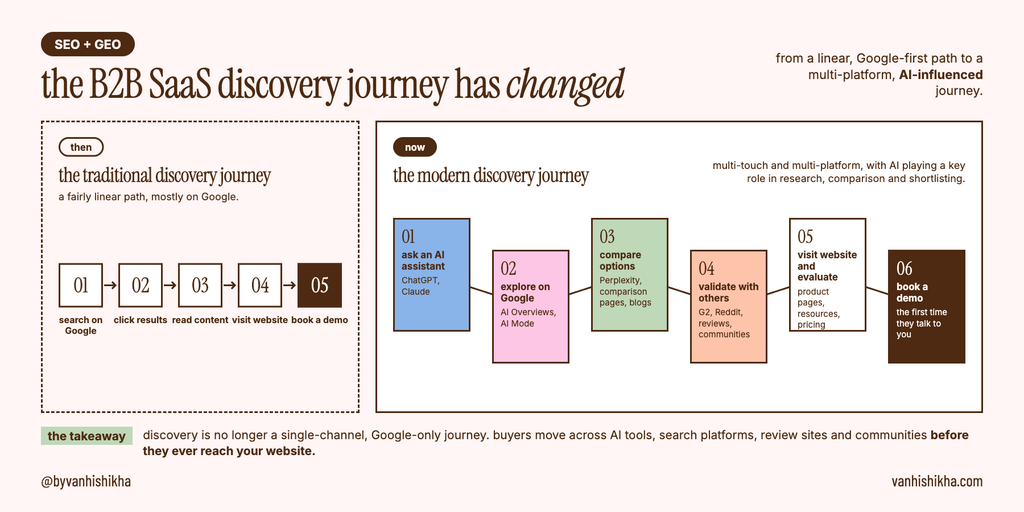
Today, a potential customer might discover your company through a Google AI Overview, ask ChatGPT to recommend software, compare products using Perplexity, validate their shortlist through G2, and eventually visit your website to book a demo.
They might never follow the traditional search journey at all.
Search is becoming more conversational, more contextual and increasingly influenced by AI-generated answers. The platforms people use to discover information are expanding, the way those platforms retrieve and present information is changing, and the signals that influence a buyer’s decision are becoming more distributed.
Yet many B2B SaaS companies are still approaching search as if the objective were simply to rank a few more pages and publish more blog posts.
That’s exactly the problem.
The next phase of search isn’t about choosing between SEO and GEO, or Google and AI search. It’s about building a business that is discoverable, understandable, credible and recommendable wherever its audience is looking for answers.
TL;DR
- Search is no longer limited to Google. Buyers are discovering brands through AI Overviews, ChatGPT, Perplexity, Copilot and other conversational search experiences.
- AI is influencing B2B buying decisions. Being recommended in AI-generated answers can help SaaS companies enter a buyer’s shortlist before they ever visit the website.
- Rankings and traffic aren’t enough. Businesses need to measure AI citations, brand mentions, recommendations, referral traffic and their contribution to qualified pipeline.
- Authority extends beyond your website. Customer reviews, third-party mentions, industry publications, communities and expert visibility all contribute to a brand’s credibility.
- Content quality beats content volume. Original research, first-hand expertise, useful frameworks and a strong technical SEO foundation matter more than publishing hundreds of AI-generated articles.
Things You Need to Know About Building Search Visibility for B2B SaaS
Here’s what B2B SaaS companies need to rethink about their search visibility strategies; straight from the conversations I’ve been having at Contensify.
1. Search Is No Longer Just About Search Engines
The first thing businesses need to understand is that search is no longer confined to traditional search engines.
Google is evolving beyond the familiar list of those ten blue links. AI Overviews provide summarised answers directly within search results, while AI Mode allows users to explore questions through more conversational interactions.
Google reported in 2026 that AI Overviews had reached more than 2.5 billion monthly users, while AI Mode had crossed one billion monthly users. Its search experiences are also becoming increasingly multimodal, allowing users to interact through text, images and other formats.
At the same time, platforms such as ChatGPT, Perplexity, Microsoft Copilot and Claude are changing how people research topics, discover solutions and evaluate products.
Consider how a B2B buyer might approach a software purchase today.
They could start with a question:
- What is the best CRM for a growing B2B SaaS company?
- Which CRM offers native AI automation?
- What are the alternatives to HubSpot for a small sales team?
- Which platforms integrate with our existing marketing stack?
Instead of searching for each question individually, they might have a conversation with an AI assistant that explores these requirements, compares products and presents recommendations.
Google is also moving towards more agentic experiences, where search can help users complete tasks rather than simply retrieve information.
The implication is significant: your audience doesn’t have to visit Google to discover your brand anymore.
This doesn’t mean Google has suddenly become irrelevant. Traditional search remains an important discovery channel, and AI-powered search experiences are increasingly integrated into existing search platforms.
What has changed is the number of places where discovery happens.
A search strategy that focuses exclusively on Google rankings is leaving out an increasingly important part of the discovery journey.
2. AI Is Moving Further Up the B2B Buying Journey
One of the most significant changes for B2B SaaS companies is the growing role of AI in product research and vendor evaluation.
Buyers are no longer using AI assistants exclusively to understand unfamiliar concepts or find quick answers. They’re using them to research software, compare alternatives, understand product capabilities and narrow down vendor shortlists.
G2’s 2026 Answer Economy research found that 71% of surveyed B2B software buyers used AI chatbots for software research. Its research also found that 69% said AI had surfaced information that changed their vendor choice.
These findings point towards an important shift: AI-generated recommendations are beginning to influence which companies make it into a buyer’s consideration set.
Think about what happens when a potential customer asks ChatGPT to recommend three software platforms for their business.
If your product isn’t mentioned, you may never enter that initial shortlist.
You might have an excellent website, a well-optimised product page and dozens of articles ranking on Google. But if your brand is missing from the conversations where buyers are researching solutions, you’re missing an opportunity to influence their decision.
Of course, AI isn’t replacing every other source of information.
Google remains part of the buying journey. Review platforms, customer testimonials, industry publications, communities and conversations with sales representatives continue to play an important role in validating purchase decisions.
Gartner’s 2026 research also highlights that B2B buyers use multiple information sources and often prefer to validate AI-generated insights with sales representatives.
This tells us that AI discovery is not the entire buying journey. It’s increasingly becoming an influential part of it.
For B2B SaaS companies, search visibility now starts before a potential customer visits your website or speaks to your sales team.
The question is no longer just whether your website appears when someone searches for a solution. It’s whether your brand is part of the conversation when someone asks which solution they should choose.
3. Ranking Is No Longer the Only Measure of Search Visibility
For a long time, rankings were one of the most visible indicators of SEO performance.
You ranked for a keyword, tracked your position, watched organic traffic grow and used those numbers to evaluate the success of your strategy.
Rankings and traffic still matter. But they don’t tell the complete story anymore.
Imagine a potential customer searching for the best project management software for a distributed team.
Google might show an AI-generated overview that compares several products, mentions their strengths and links to relevant sources.
Your company might not rank first for the original keyword, but it could still be cited in that overview.
Another company might rank first organically but never appear in the AI-generated response.
Which company has better visibility in that particular search experience?
This is where traditional SEO measurement starts falling short.
Search visibility now needs to account for several different outcomes:
- Rankings: Does your website appear for relevant search queries?
- Citations: Are your pages being used as sources in AI-generated answers?
- Brand mentions: Is your company being discussed in relevant AI conversations?
- Recommendations: Is your product being included when buyers ask for solutions?
- Referral traffic: Are users visiting your website from AI platforms?
- Business impact: Is search contributing to qualified leads, opportunities and revenue?
The measurement infrastructure is also beginning to catch up.
Google Search Console introduced generative AI performance reporting in 2026, giving site owners more visibility into how their pages appear across AI search experiences.
Bing Webmaster Tools also introduced AI Performance reporting, including cited pages, grounding queries and citation trends across supported AI experiences.
These developments are important because AI visibility is moving beyond screenshots of individual prompts and anecdotal observations.
However, there’s still a measurement challenge.
AI-influenced discovery doesn’t always result in an identifiable AI referral. Someone might discover your company through ChatGPT, remember its name, search for it on Google a few days later and eventually book a demo.
Your analytics platform might attribute that conversion to organic search or direct traffic, even though AI played a role earlier in the journey.
This is why measuring AI search performance purely through referral traffic can be misleading.
Rankings, clicks and traffic remain important metrics. But they need to sit alongside citations, brand visibility, recommendations and business outcomes.
The objective isn’t to replace one set of vanity metrics with another. It’s to understand how search contributes to the entire buying journey.
4. Your Website Is Not Your Entire Search Footprint
Here’s something businesses need to get comfortable with: your website is no longer the only place where your search visibility is built.
Think about the information available about a typical B2B SaaS company.
There’s the company’s website, of course. But there might also be product reviews on G2, comparison pages on industry websites, customer discussions on Reddit, founder interviews, YouTube demonstrations, LinkedIn posts, independent reviews and mentions in industry publications.
All of these contribute to the wider digital footprint of the brand.
They also give potential customers different ways to understand and evaluate the company.
This matters because AI-powered search experiences can retrieve and synthesise information from multiple sources. Buyers, meanwhile, rarely rely on a company’s own marketing claims when making a significant software purchase.
They want independent validation.
They want to know what customers think, how a product compares with alternatives, whether it delivers on its promises and what real-world experience looks like.
For B2B SaaS companies, this makes several activities increasingly important:
- Building a credible presence on relevant review platforms.
- Encouraging detailed, genuine customer reviews.
- Publishing case studies that demonstrate actual outcomes.
- Getting included in relevant industry comparisons.
- Building relationships with industry publications and experts.
- Developing founder and subject-matter expert visibility.
- Participating meaningfully in relevant industry communities.
Notice that none of these activities is simply about publishing another blog post.
They’re about building a brand that has a credible presence beyond its own website.
This is also where digital PR, link building, content distribution and brand marketing begin to overlap with search visibility.
A backlink from a relevant industry publication can support discoverability and authority. A detailed customer review can help a buyer validate a product. An expert interview can establish credibility. A useful founder perspective can give people another reason to recognise and trust a brand.
But there’s an important distinction here.
Being mentioned everywhere is not the same as building authority.
Mass-produced guest posts, irrelevant directory listings and artificial brand mentions are not a sustainable substitute for genuine recognition.
The objective should be to build a digital footprint that accurately reflects what your company does, what it knows and why people should trust it.
Your website tells people what you claim. The wider web helps establish whether they should believe you.
5. Topical Authority Is Becoming More Important Than Content Volume
Let’s talk about content marketing.
For years, businesses have been encouraged to publish more.
More blog posts. More keywords. More landing pages. More topic clusters. More content variations.
And now, with generative AI making content production faster and cheaper, the temptation to scale publishing has become even greater.
But producing more content doesn’t automatically create more visibility.
In fact, it can create the opposite problem.
Many B2B SaaS websites have accumulated hundreds of articles covering similar topics, answering the same questions and targeting slightly different keyword variations.
Some are outdated. Some offer very little original information. Others repeat what every competing website has already published.
The result is a large content library that doesn’t necessarily communicate meaningful expertise.
Google’s guidance for its generative AI search experiences reinforces the importance of helpful, original and expert-led content. It also cautions against creating large volumes of pages simply to capture query variations.
This is an important distinction.
AI systems can summarise existing information remarkably well. If your article simply repeats information available across dozens of other websites, what makes it worth citing?
What does your company know that others don’t?
What experience can you bring to the conversation?
What data, research, frameworks or examples can you share?
For a B2B SaaS company, this could mean publishing:
- Original research based on customer or industry data.
- Detailed implementation guides based on actual product experience.
- Case studies that explain how customers solved specific problems.
- Expert commentary on changes affecting the industry.
- Product comparisons backed by genuine feature knowledge.
- Frameworks developed through real-world implementation.
- Insights from customer support, sales and product teams.
It also means building connected areas of expertise rather than publishing disconnected articles around every available keyword.
If your company sells a CRM, for example, your content shouldn’t stop at generic articles about CRM software.
It should demonstrate an understanding of sales processes, pipeline management, automation, lead qualification, integrations, reporting, implementation challenges and the specific problems your product solves.
That is how you demonstrate depth.
Topical authority isn’t about publishing everything related to a keyword. It’s about demonstrating that your business has a meaningful understanding of the subject.
The advantage in 2027 won’t come from publishing more information. It will come from publishing information that adds something the rest of the internet doesn’t already have.
6. GEO Is Not a Replacement for SEO
The industry has spent a considerable amount of time debating SEO, GEO, AEO and LLM SEO.
New terminology has emerged, new service categories have appeared, and an entire industry of AI visibility tools and consultants has developed around the opportunity.
But one thing needs to be made clear: GEO isn’t a replacement for SEO.
AI search platforms still need to discover, retrieve and evaluate information. The technical accessibility of your website, the quality of your content, the relevance of your information and the credibility of your brand continue to matter.
Google’s own guidance for appearing in its AI search experiences reinforces this. It doesn’t require a completely separate set of optimisation techniques or special AI-only markup.
In fact, Google has explicitly clarified that:
- There is no requirement to create an llms.txt file for Google AI Search.
- There is no requirement to break all content into smaller chunks.
- There is no special schema markup required specifically for AI features.
- Rewriting content exclusively for AI systems is unnecessary.
- Mass-producing pages around every possible query variation is not a sustainable strategy.
This doesn’t mean technical optimisation is becoming less important.
It means businesses need to understand what actually makes information accessible, useful and trustworthy rather than chasing every new GEO tactic that appears online.
Search visibility strategy still needs to address:
- Technical SEO: Can search engines and relevant AI crawlers access, crawl and understand your website?
- Content architecture: Is your information organised logically, with clear relationships between topics, products and supporting pages?
- Content quality: Does your content answer the question meaningfully, with original insights and relevant experience?
- Authority: Is your brand recognised and referenced by credible sources across the web?
- Brand clarity: Can someone understand what your company does, who it serves and why it is different?
There is also a platform-specific technical consideration.
Different AI platforms use different crawlers, retrieval systems and access mechanisms. For example, OpenAI distinguishes its search crawler, OAI-SearchBot, from GPTBot, which is associated with model training. Perplexity also documents different mechanisms for search discovery and user-initiated page access.
Businesses should understand these distinctions when making decisions about crawler access and content permissions.
Blocking every AI crawler without understanding its purpose could prevent your content from being discovered in the very search experiences where you want to appear.
The bigger point is this:
You don’t need separate SEO and GEO strategies competing for resources. You need an integrated search visibility strategy that accounts for how different platforms discover and present information.
7. Search Visibility Needs a New Measurement Framework
If the way people discover information is changing, the way businesses measure search performance needs to change too.
Traditional SEO reporting often focuses on rankings, organic traffic, impressions, clicks and conversions.
These metrics remain useful. But they don’t capture every way search influences a buying decision.
Consider a company that starts appearing in ChatGPT recommendations for relevant software queries.
Its AI referral traffic might be relatively small. However, more people may start searching for its brand, reading its product pages, visiting review platforms or including it in their shortlist.
If the company only measures identifiable AI referral sessions, it could underestimate the impact of that visibility.
This is why I would approach search measurement across five layers.
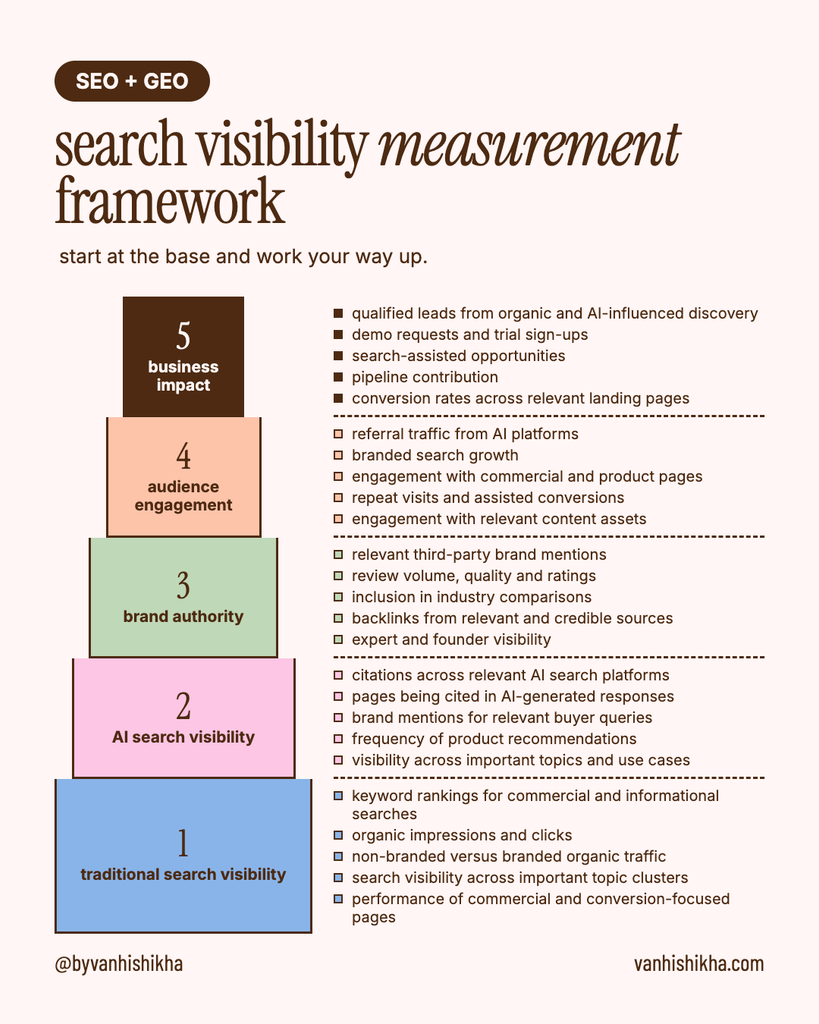
Traditional search visibility
- Keyword rankings for relevant commercial and informational searches.
- Organic impressions and clicks.
- Non-branded versus branded organic traffic.
- Search visibility across important topic clusters.
- Performance of commercial and conversion-focused pages.
AI search visibility
- Citations across relevant AI search platforms.
- Pages being cited in AI-generated responses.
- Brand mentions for relevant buyer queries.
- Frequency of product recommendations.
- Visibility across important topics and use cases.
Brand authority
- Relevant third-party brand mentions.
- Review volume, quality and ratings.
- Inclusion in industry comparisons.
- Backlinks from relevant and credible sources.
- Expert and founder visibility.
Audience engagement
- Referral traffic from AI platforms.
- Branded search growth.
- Engagement with commercial and product pages.
- Repeat visits and assisted conversions.
- Engagement with relevant content assets.
Business impact
- Qualified leads from organic and AI-influenced discovery.
- Demo requests and trial sign-ups.
- Search-assisted opportunities.
- Pipeline contribution.
- Conversion rates across relevant landing pages.
Not every platform provides all these metrics directly, and AI visibility measurement is still evolving. Some metrics will require structured manual testing alongside available platform reporting.
The important thing is to avoid treating every citation as a business outcome or every ranking as evidence of commercial success.
The objective is to understand how search contributes to awareness, consideration and revenue, not just how many visitors it sends to your website.
What B2B SaaS Companies Should Do Differently in 2027
So, what does all of this mean in practice?
Should companies abandon their existing SEO strategies and start investing everything in GEO?
Absolutely not.
The opportunity is to build a more integrated search visibility programme that accounts for traditional search, AI discovery, brand authority and the wider buying journey.
Here are seven things I would prioritise.
1. Revisit your positioning before producing more content
If your website takes three paragraphs to explain what your product does, you have a positioning problem.
Your product pages, homepage, about page and supporting content should clearly communicate what you offer, who it is for, what problem it solves and why someone should choose you.
AI systems and human buyers both need clear, consistent information to understand your business.
Start with the fundamentals. Make your positioning difficult to misunderstand.
2. Audit your existing search footprint
Before investing in another 50 articles, understand what you already have.
Review your existing pages, blogs, product content and topic clusters. Identify:
- Pages that are outdated or no longer relevant.
- Multiple pages competing for the same search intent.
- Topics where you lack meaningful coverage.
- Content that offers no original insight.
- Important commercial queries you aren’t addressing.
- Opportunities to strengthen existing pages with customer evidence and product expertise.
The objective is not to keep publishing on top of an already messy content library. It’s to make your existing search footprint more useful, relevant and authoritative.
3. Build topical authority around your actual expertise
Stop chasing every keyword that has search volume.
Identify the topics your ideal customers care about and where your business has genuine expertise.
Build connected content around those topics, covering the problems, use cases, comparisons, implementation questions and decisions that influence a purchase.
Involve your product, sales and customer success teams. They often have insights that your marketing team won’t find through keyword research alone.
The best content opportunities are frequently hiding inside customer conversations.
4. Publish original information, not another version of what’s already ranking
If your content can be recreated by asking an AI tool to summarise the top five Google results, you need to rethink the value you’re adding.
Bring something original to the table.
Publish proprietary research, customer insights, implementation experiences, product comparisons, expert opinions and practical frameworks.
Use AI to improve your research and production processes, not to manufacture the expertise your business hasn’t developed.
5. Build authority beyond your website
Invest in the places where your audience looks for independent information.
Build a genuine presence on review platforms, participate in relevant communities, contribute to industry publications, develop founder visibility and create customer stories worth referencing.
Don’t treat digital PR, brand building, content distribution and link acquisition as disconnected marketing activities.
They can all contribute to a stronger and more credible digital footprint when executed with a clear purpose.
6. Fix technical discoverability
Make sure your website is technically accessible to the search platforms you want to appear on. Review indexing, crawling, internal linking, page experience, structured data and content accessibility.
Understand which AI crawlers you want to allow and what permissions you want to give them.
Don’t implement technical changes simply because someone claims they’re a new GEO requirement. Prioritise changes based on actual platform documentation and measurable business needs.
7. Rethink how you measure performance
Move beyond reporting rankings and organic sessions as the only indicators of success.
Track traditional search performance alongside AI citations, brand mentions, referral traffic, branded search growth and qualified pipeline.
Build a measurement framework that helps your marketing team understand which topics, platforms and activities are contributing to business outcomes.
And be honest about attribution limitations. Not every AI-influenced conversion will show up as an AI referral.
Conclusion
Search will continue to change.
Google will introduce new search experiences. AI platforms will evolve their retrieval systems. New ways of discovering and evaluating information will emerge.
But the underlying requirement for businesses won’t change.
People need to discover you. They need to understand what you offer. They need a reason to trust you. And they need to believe you’re the right choice for their problem.
That requires more than keyword optimization.
It requires a clear brand, useful content, technical accessibility, credible authority and a consistent presence across the digital ecosystem.
For B2B SaaS companies, these aren’t separate marketing initiatives.
Your positioning influences how people understand your product. Your content demonstrates what you know. Your SEO helps people discover that information. Your digital presence builds credibility. And your search visibility brings all of these efforts together.
The platforms may change, but businesses will always need to be discoverable, relevant and trusted.
Well, that’s all from the conversations and projects we’ve been working on this year. If we haven’t spoken already, there’s still time.
Let’s connect and discuss how you’re going to handle search visibility.