If you’ve spent any time around the SEO industry lately, you’ve probably noticed that everyone has a new acronym to sell you.
SEO was the thing to do. Then GEO became the thing to do. AEO started appearing in agency service menus (yes, mine too). And now LLM SEO is making its way into conversations, proposals and LinkedIn headlines.
Suddenly, everyone is optimising for something.
The problem? Most businesses are still trying to figure out what these terms actually mean, whether they need all four, and whether their existing SEO strategy is now somehow outdated.
I’ve been in the SEO and content marketing space for over 14 years. And if there’s one thing I’ve learnt, it’s that the industry has a habit of giving new names to things before we’ve fully understood what has actually changed.
So let’s simplify this.
What do SEO, GEO, AEO and LLM SEO mean? Where do they overlap? What makes them different? And, more importantly, what should businesses actually invest in?
Let’s get into it.
SEO vs GEO vs AEO vs LLM SEO: What’s the difference?
Before we get into the details, here’s a quick overview of search visibility in 2027 (especially if you’re still in a rush like everyone else):
| Discipline | Stands for | Primary focus | Where it applies |
| SEO | Search Engine Optimization | Improving a website’s visibility in organic search results | Google, Bing and other search engines |
| GEO | Generative Engine Optimization | Improving a brand’s visibility in AI-generated responses | Google AI Overviews, AI Mode, ChatGPT, Perplexity and other generative search experiences |
| AEO | Answer Engine Optimization | Making content discoverable and useful for platforms that provide direct answers | Featured snippets, voice assistants, answer engines and AI-powered search |
| LLM SEO | Large Language Model SEO | Improving how a brand, its content and its products are discovered, understood and represented by LLM-powered platforms | ChatGPT, Claude, Perplexity and other LLM-based experiences |
These definitions are useful working definitions, not universally agreed industry standards. Different practitioners and platforms use these terms differently.
And that’s partly why the conversation gets confusing.
What is SEO (Search Engine Optimization)?
SEO is the process of improving a website’s visibility in unpaid search engine results so that people can discover relevant information, products or services when they search for them.
In simpler terms, SEO helps your business show up when someone searches for something related to what you offer.
If someone searches for “best CRM for SaaS companies” and your CRM website appears among the relevant organic results, that’s SEO at work.
SEO isn’t just about adding keywords to pages or getting backlinks. It involves several interconnected components.
Key components of SEO
1. Technical SEO
Making sure search engines can access, crawl, render, understand and index your website. This includes website architecture, crawlability, indexing, site speed, mobile experience, canonicalisation, redirects, structured data and other technical elements.
2. On-page SEO
Optimising individual pages so search engines and users can understand what they are about and how relevant they are to a search query. This includes page titles, headings, content structure, internal links, metadata and the actual information presented on the page.
3. Content SEO
Creating useful, relevant and comprehensive content that addresses what your audience is searching for. This includes keyword research, search intent analysis, content strategy, topic clusters, content optimisation and content refreshes.
4. Off-page SEO
Building your website’s credibility and authority through signals beyond your own website.
This traditionally includes backlinks, digital PR, brand mentions and other forms of third-party recognition.
Why SEO is still the foundation of search visibility
Here’s where things get interesting.
With AI-powered search experiences becoming more prominent, there’s been a tendency to assume that traditional SEO is losing relevance.
But Google’s own documentation says otherwise.
Google’s AI Overviews and AI Mode use its existing Search ranking and quality systems. They retrieve relevant information from the Search index and use it to generate responses with supporting links.
Google has also explicitly stated that the best practices for SEO remain relevant to its generative AI search experiences. There are no additional technical requirements or special optimisations required to appear in AI Overviews or AI Mode.
So, if someone tells you that SEO is dead and you should abandon it for GEO, you might want to ask them what exactly they’re proposing you abandon.
Technical accessibility, relevant content, useful information, a well-structured website and credibility don’t suddenly become irrelevant because the interface displaying search results has changed.
Let’s say you run a SaaS company that offers an AI-powered CRM for growing sales teams. Someone searches for “best CRM for small B2B SaaS companies”.
Your SEO strategy would involve:
- Creating a well-optimised product or category page targeting the relevant commercial intent.
- Publishing useful content around CRM selection, sales automation and pipeline management.
- Building supporting topic clusters around related customer problems.
- Ensuring your website is technically accessible and easy to navigate.
- Earning relevant backlinks and strengthening your website’s authority.
The objective is to make your website visible when potential customers search for relevant products, solutions and information.
That’s SEO. And it’s still a very important part of the equation.
What is GEO (Generative Engine Optimization)?
GEO stands for Generative Engine Optimization. It refers to the practice of improving a brand’s visibility in responses generated by AI-powered search and generative engines.
Unlike traditional search, where users are presented with a list of pages to explore, generative engines can synthesise information from multiple sources and present a consolidated response.
For example, someone might ask ChatGPT:
“Which CRM platforms are best for a B2B SaaS company with a 20-person sales team?”
Instead of receiving ten blue links, they might receive a shortlist of products, a comparison of features, relevant recommendations and links to supporting sources.
GEO focuses on increasing the likelihood that your brand, products, expertise or content are included in these responses.
Key components of GEO
1. Brand visibility in AI-generated responses
Understanding whether your brand appears when people ask relevant questions about your industry, category, products or solutions.
2. Content that can be retrieved and referenced
Creating useful, well-organised information that provides clear answers, context and supporting evidence.
3. Topical authority
Demonstrating depth of knowledge across the subjects your business wants to be associated with, rather than publishing isolated articles around individual keywords.
4. Third-party credibility
Building a credible presence through independent reviews, industry publications, expert commentary, customer stories and other relevant sources.
5. Clear brand and entity information
Making it easy to understand what your company does, who it serves, what its products offer and how it relates to the wider industry.
Why GEO matters
The way people discover information is changing.
Buyers increasingly use AI-powered platforms to research products, compare alternatives and understand unfamiliar categories.
For businesses, this creates another opportunity to be discovered.
Imagine two SaaS companies selling similar products.
Both have websites. Both have optimized product pages. Both publish content.
But when someone asks an AI platform to recommend solutions for a specific use case, only one consistently appears in the responses.
That company has an advantage in that discovery experience.
GEO is about understanding what influences that visibility and building a strategy around it.
However, there’s an important caveat.
No GEO strategy can guarantee that an AI platform will mention or recommend your brand. These systems use different retrieval mechanisms, models and sources, and their responses can vary.
The objective is to improve your brand’s eligibility, relevance and credibility across these experiences, not to manufacture a guaranteed citation.
Let’s take the same AI-powered CRM company.
A GEO strategy would involve:
- Building detailed content around CRM use cases, comparisons, integrations and implementation.
- Publishing original insights about sales operations and CRM adoption.
- Developing credible customer case studies with measurable outcomes.
- Building independent brand mentions and relevant third-party coverage.
- Ensuring product information is consistent and accurate across the web.
- Monitoring whether the brand appears in relevant AI-generated answers.
The objective isn’t simply to get a blog post cited by ChatGPT. It’s to make the company a credible source of information and a relevant recommendation when buyers research the category.
What is AEO (Answer Engine Optimization)?
AEO stands for Answer Engine Optimization. It refers to optimising content so that it can be discovered, understood and surfaced by platforms that provide direct answers to user questions.
Think about the difference between these two searches:
“CRM software”
“How does CRM automation help a sales team?”
The first might return a list of software products. The second is more likely to require an explanation.
Answer engines attempt to satisfy these information needs directly, sometimes without requiring the user to visit multiple websites.
AEO has traditionally been associated with featured snippets, voice search and direct-answer experiences. Today, the definition increasingly overlaps with AI-powered answer experiences.
Key components of AEO
1. Question-focused content
Understanding the questions your audience actually asks and creating content that answers them clearly.
2. Direct and structured answers
Providing concise, meaningful answers before expanding into supporting explanations.
3. Content organisation
Using descriptive headings, logical sections, lists, tables and other structures that make information easier to navigate and understand.
4. Relevant structured data
Using appropriate schema markup to help search engines understand the content and entities represented on a page. This should accurately reflect the visible information and follow the relevant platform guidelines.
5. Comprehensive topic coverage
Addressing related questions, follow-up considerations and the context behind a user’s original question.
Why AEO matters
People don’t always search using short keywords anymore. They ask questions.
They use conversational language. They add context. They ask follow-up questions. They expect answers that address their specific situation.
This is particularly relevant for businesses operating in complex categories where customers need to understand a product, its features, limitations and use cases before making a decision.
AEO helps businesses make their information more accessible in these answer-oriented discovery experiences.
But let’s clear up one misconception. AEO isn’t simply about adding an FAQ section to every page. Nor does putting a question in an H2 heading automatically make your content eligible for a featured snippet or AI-generated answer.
The real objective is to provide a useful, accurate answer in a format that is easy for people and search systems to understand.
For our CRM company, potential questions could include:
- What is an AI-powered CRM?
- How does CRM automation work?
- What is the difference between a CRM and a sales engagement platform?
- How much does CRM software cost?
- How do you migrate from one CRM to another?
An AEO strategy would involve identifying these questions, understanding the intent behind them and creating useful content that answers them directly.
For example, a page explaining CRM automation could start with a clear definition, followed by how it works, common use cases, benefits, limitations and implementation considerations. The idea is to make the answer useful without forcing someone to read five paragraphs before getting to the point.
What is LLM SEO (Large Language Model SEO)?
LLM SEO stands for Large Language Model SEO. It’s a term used to describe the practice of improving a brand’s discoverability and representation across platforms powered by large language models.
These platforms include ChatGPT, Claude, Perplexity and other LLM-powered interfaces.
The focus isn’t limited to whether a particular URL gets cited.
It’s also about whether the platform understands your brand, recognises what your product does, associates your company with the right category and represents your business accurately when users ask relevant questions.
For example, imagine someone asks an LLM:
“Tell me about CRM platforms built specifically for growing B2B SaaS sales teams. Which ones should I consider?”
Does the platform understand your product category?
Does it know your key features?
Does it recognise your company as a relevant option?
Does it have accurate information about your pricing, integrations and use cases?
These are the kinds of questions LLM SEO attempts to address.
Key components of LLM SEO
1. Brand and entity understanding
Ensuring your company, products, people and areas of expertise are clearly represented across your website and credible external sources.
2. Consistent information
Maintaining accurate product descriptions, company information, feature details, pricing and positioning across different platforms.
3. Content discoverability
Making sure relevant content can be accessed by the search and retrieval systems used by different LLM-powered platforms.
4. Topical and contextual relevance
Building a meaningful association between your brand and the subjects, problems and solutions you want to be known for.
5. Platform-specific visibility monitoring
Testing how your brand appears across relevant LLM-powered experiences and tracking changes in mentions, citations and recommendations.
Why LLM SEO matters
One of the biggest differences between traditional search and LLM-powered discovery is that users may not always be looking for a specific page.
They may be looking for a recommendation, an explanation, a comparison or a solution to a problem.
And the platform may use information from multiple sources to construct its response.
This means your visibility depends on more than having one well-optimised page.
Your product information, website content, customer evidence, third-party mentions and overall brand footprint can all contribute to how your business is discovered and represented.
It’s also important to remember that not every LLM works in the same way.
ChatGPT Search, Claude’s web search capabilities and Perplexity have different retrieval experiences, access mechanisms and ways of presenting sources.
LLM SEO therefore needs to account for the platforms that actually matter to your audience, rather than assuming one set of tactics will work everywhere.
For our CRM company, LLM SEO would involve:
- Ensuring the company has a clear and consistent identity across its website and credible external sources.
- Making product features, integrations, pricing and use cases easy to understand.
- Creating content that establishes the company’s expertise in sales automation and CRM technology.
- Ensuring relevant search crawlers can access the website.
- Building credible references through reviews, industry publications and customer stories.
- Testing how different LLM platforms describe and recommend the product.
The objective is to help LLM-powered platforms understand the company accurately and recognise when it is relevant to a user’s needs.
What do SEO, GEO, AEO and LLM SEO have in common?
Now that we’ve looked at each discipline individually, you’ll probably have noticed something.
They share a lot of the same foundations.
In fact, if you were to look at the actual work involved in executing these strategies, you’d find that much of it overlaps.
Here’s what they have in common:
1. They all start with understanding your audience.
Whether someone is searching on Google or asking ChatGPT a question, the starting point is the same: understanding what they’re looking for, why they’re looking for it and what information would help them.
Search intent doesn’t disappear just because the interface changes.
2. They all need useful, relevant content.
You cannot build meaningful visibility by producing content that says very little.
Your content needs to answer questions, demonstrate expertise, provide context and help people make decisions.
3. They depend on discoverability.
Your information needs to be accessible to the systems that retrieve and surface it.
That means technical accessibility, sensible website architecture, internal linking and content that can be understood.
4. They benefit from authority and credibility.
A website that consistently demonstrates expertise and earns recognition from credible sources has a stronger foundation for search visibility.
Backlinks, customer evidence, reviews, original research and third-party references all have a role to play, although their influence varies across platforms.
5. They require ongoing optimisation.
Search isn’t a one-time activity.
Content becomes outdated. Products evolve. Competitors improve. Search experiences change.
Whether you’re working on SEO or GEO, you need to keep reviewing performance and improving what isn’t working.
So, what is actually different?
If the four disciplines share so much, why do we have four different terms?
Because the discovery experiences, systems and outcomes we’re trying to influence aren’t identical.
Here’s a simpler way to look at it:
| Area | SEO | GEO | AEO | LLM SEO |
| Primary objective | Organic search visibility | Visibility in generative responses | Visibility in direct answers | Discoverability and accurate representation across LLM platforms |
| Main focus | Pages and websites | Brands, content and sources | Questions and answers | Brands, entities, products and information |
| Typical outcome | Ranking and organic clicks | AI mentions and citations | Featured answers and direct responses | LLM mentions, recommendations and accurate brand representation |
| Key considerations | Technical SEO, content, links, relevance | Content quality, authority, citations and relevance | Answer clarity, structure and intent | Entity clarity, content access, external references and platform behaviour |
These aren’t strict boundaries.
A page can rank in Google, be used as a source in an AI Overview, answer a question through a featured snippet and be retrieved by an LLM-powered search experience.
The same content can contribute to several of these outcomes.
That’s why treating these as four entirely separate marketing functions can create unnecessary complexity.
How SEO, GEO, AEO and LLM SEO fit together
This is probably the most important part of the entire conversation.
I wouldn’t look at SEO, GEO, AEO and LLM SEO as four independent strategies that need separate budgets, teams and content calendars.
I’d look at them as interconnected disciplines that contribute to one larger objective: search visibility.
Think of them as a pyramid:
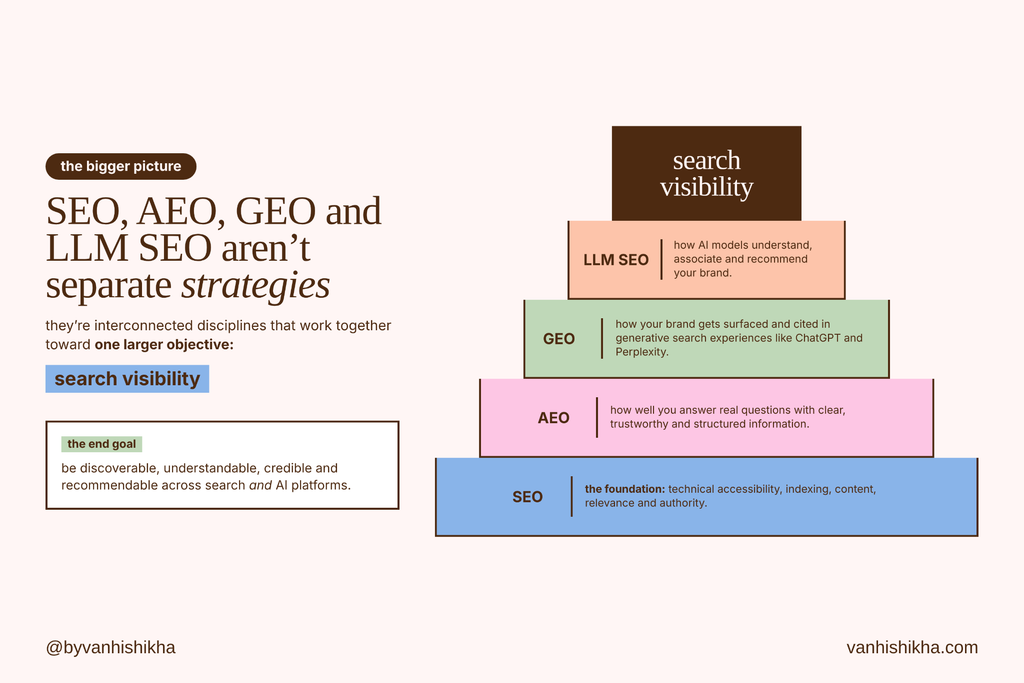
Now here’s how to understand the pyramid:
SEO is the foundation.
Your website needs to be discoverable, accessible, relevant and useful. Without these fundamentals, you’re already making it harder for search systems to find and understand your information.
AEO builds on how your information answers questions.
Your content should address the questions your audience asks, provide clear answers and make information easy to navigate and understand.
GEO extends that effort into generative search experiences.
You want your content, expertise and brand to be discoverable and useful when AI systems generate responses using information from different sources.
LLM SEO focuses more closely on how your brand is understood and represented across LLM-powered platforms.
You want these systems to understand what your business does, what it offers, who it serves and when it is relevant to a user’s needs.
But remember, these aren’t sequential tasks. You don’t finish SEO, move on to AEO, then GEO and finally LLM SEO.
A well-structured article can contribute to all four. A strong product page can do the same. A technically accessible website, clear positioning and credible brand presence support the entire ecosystem.
And this brings me to something Google has been reiterating in its Search Central guidance and educational resources.
Good GEO is good SEO.
Google’s official guidance on generative AI features explicitly states that existing SEO best practices remain relevant. Its systems use existing Search ranking and quality systems, retrieve relevant pages from its Search index and surface supporting links in AI-generated responses.
Google has also been clear that there are no special technical requirements, AI-only files or dedicated schema markups required to appear in AI Overviews or AI Mode.
In other words, you don’t need to throw away your SEO strategy and start from scratch because someone has introduced a new acronym. You need to make sure the strategy you’re already investing in is strong enough to support how search is evolving.
What should businesses actually invest in?
If you’re a business owner or marketing leader, you probably don’t care about winning an argument over which acronym is more relevant.
You care about getting discovered by the right audience.
So, instead of creating four separate strategies, start by asking a few practical questions:
- Can people find our website when they search for the problems we solve?
- Does our content demonstrate genuine expertise in our category?
- Can search systems access and understand our most important information?
- Are we appearing in relevant AI-generated answers and product recommendations?
- Do credible third-party sources validate what we claim about our business?
- Are AI platforms representing our brand and products accurately?
- Can we connect our search visibility efforts to actual business outcomes?
The answers will help you identify where your strategy needs work.
For one business, the biggest opportunity might be fixing technical SEO issues and building a stronger content architecture.
For another, it might be improving brand positioning, publishing original research and strengthening its presence on independent review platforms.
And for a third, it might be addressing the fact that its website ranks well but its products are almost invisible in AI-generated recommendations.
The strategy should follow the problem, not the acronym.
Conclusion
You don’t need to rap all four terms like Eminem.
SEO, GEO, AEO and LLM SEO aren’t competing disciplines.
They represent different ways of approaching the same larger challenge: helping your business become discoverable, relevant and credible wherever people are looking for information.
The terminology will continue to evolve. New platforms will emerge, existing ones will change, and the industry will probably come up with another acronym before we’ve finished debating these four.
But the fundamentals remain remarkably consistent.
Build a technically sound website. Publish useful, original content. Demonstrate expertise. Build credibility beyond your own website. Make it easy for people and search systems to understand what you do.
You don’t need to choose between SEO, GEO, AEO and LLM SEO. You need a strategy that accounts for all of them.
And if you don’t want to keep rattling off four acronyms and stringing them together like Eminem, there’s a much simpler term for the whole thing.
Search Visibility.
That’s what we’re really trying to build.
And if that’s you, let’s talk and discuss how we can make your company more visible across search engines.