AI search has quietly changed the game of content marketing and SEO.
Google’s AI Overviews, ChatGPT, Perplexity, Claude, and other AI systems are no longer just sending traffic to a website that ‘ranks’.
They’re deciding who gets quoted, cited, and trusted.
Which only goes to say that:
- Being on page 1 isn’t enough
- High traffic doesn’t guarantee visibility
- Fluffy, surface-level content disappears faster
In AI search, content wins when it is:
- Easy to understand
- Easy to extract
- Easy to trust
In short, if you’ve spent the last year just creating and publishing a lot of content with the help of AI tools because it felt ‘faster’, your success isn’t guaranteed.
But over the last few months of obsessing over AI citations, looking at examples, experimenting with different strategies and hot takes being shared by industry experts, me and my team at Contensify were able to find a few ways to win.
In this post, I’m going to share the 15 practical tips you can follow to create content that ranks, shows up in AI searches and compounds authority over time.
15 tips to create content that wins in AI search (and SEO, because it still matters)
The following tips are based on the best practices and experiments we have run for our clients. While they’re sure to work for everyone, we do recommend closely monitoring their impact when you get started.
1. Write for Humans First (Always)
This sounds obvious. It’s also where most AI-optimized content fails.
AI systems are trained to prioritize clarity of meaning, not keyword density. If your content feels confusing, bloated, or over-optimized to a human, it will almost certainly underperform in AI search.
Here’s what to do instead:
- Use simple language to explain complex ideas
- Write as if you’re answering a real person, not a crawler
- Remove anything that doesn’t add clear value
Think of it this way – If a human doesn’t trust your content, AI won’t either.
Pro tip: If you want to simplify your content, you should proactively talk to your sales and support teams.
2. Align Every Page to a Clear User Intent
AI doesn’t “rank pages.”
It matches intent to answers.
Before writing, you need to be brutally clear about:
- What exact question is this page answering?
- Is the intent informational, comparative, or decision-driven?
Some of the best practices we’ve always followed that help with AI optimization:
- One primary intent per page
- Secondary intents handled via clearly separated sections
Pages that try to do everything usually end up doing nothing well. Honestly, this isn’t new but somewhere down the line, everyone forgot about this golden rule in their zeal to sound the smartest.
3. Structure Content So AI Can Parse It Easily
AI systems rely heavily on structure to understand and extract information.
Well-structured content:
- Gets summarized more accurately
- Is easier to cite
- Appears more frequently in AI answers
Structure signals that matter:
- Clear H2s and H3s
- Short, focused paragraphs
- Bulleted lists and numbered steps
- Logical flow from problem → explanation → solution
Think of structure as machine-readable clarity for humans. Yes, in other words, please focus on your formatting.
If you wouldn’t read a piece, there is a high chance that your audience and AI won’t either.
4. Use Direct, Explicit Answers (Don’t Bury the Lead)
AI models prefer content that answers questions immediately.
If your page answers:
“How do you optimize content for AI search?”
Then the answer should appear clearly and early, not hidden halfway down the page.
Example pattern:
- Direct answer in 2-3 sentences
- Followed by explanation, context, and examples
This dramatically increases the chances of being quoted verbatim in AI responses.
Pro tip: Focus on adding headings directly relevant to the topic right after the introduction. The other supporting sections can always follow.
5. Modularize Content for Easy Extraction
AI doesn’t always pull entire sections.
You may have heard this before, but I’m going to say it again – AI pulls information blocks.
Design your content so sections can stand alone.
Here are some high-value elements I recommend adding:
- Definitions
- TL;DR summaries
- Step-by-step frameworks
- Comparison tables
- “What to do instead” callouts
If a section can be lifted without losing meaning, it’s AI-friendly.
6. Use Schema and Structured Data Strategically
Schema doesn’t make content good, but it makes good content understandable.
At a minimum, pillar pages should include:
- Article schema
- Author information
- FAQ schema (where relevant)
Schema helps AI systems:
- Understand content type
- Identify authoritative sources
- Extract precise answers
It’s not optional anymore. It’s fundamental; back then we called it a part of technical SEO.
7. Build Real Authority (Not Synthetic Expertise)
AI systems are increasingly sensitive to who is speaking, not just what’s being said.
Authority signals include:
- Clear author attribution
- Demonstrated experience
- Original thinking, not rewrites
What weakens authority fast:
- Generic advice
- Regurgitated SEO content
- “Ultimate guides” with nothing new to say
AI prefers sources that show judgment, not just information. So that ‘opinion’ you have about a certain subject needs to start getting shared.
8. Add Original Insights, Data, or POVs
AI models already know what’s common knowledge.
What they value more now includes:
- Original frameworks
- Operator insights
- First-hand observations
- Pattern recognition across cases
Even small original insights (what fails, trade-offs, edge cases) can significantly improve citation potential.
So yes, while AI has been helping you create content faster, it does want you to work harder to create ‘better’.
9. Write in a Conversational, Natural Tone
AI search is powered by conversational queries.
Your content should:
- Match how people actually ask questions
- Use natural phrasing
- Avoid over-formal, academic language
This helps AI systems match your content more accurately to real-world prompts.
PS. Let me just mention here how over-obsessing over ‘what prompts our audience uses’, is futile. You and I don’t speak or write the same way and that holds true to our AI searches too.
10. Optimize for Semantic Coverage (Not Keyword Stuffing)
AI understands topics holistically.
Instead of repeating keywords:
- Cover related subtopics
- Answer adjacent questions
- Use natural variations
Ask: “If someone wanted a complete understanding of this topic, what else would they need to know?”
That’s semantic optimization.
And it’s also referred to as the pillar-cluster or hub-spoke model that I’ve been talking about for the last 13 years. Yes, giving your audience related topics is an evergreen strategy.
11. Refresh Content Regularly (AI Penalizes Staleness)
AI systems prioritize freshness and accuracy, especially for evolving topics.
Stale content or content decay risks:
- Being skipped
- Being contradicted by newer sources
- Losing trust signals
Now you don’t need to keep updating your content everyday. Here are some best practices to follow:
- Quarterly refresh for core pages
- Update stats, examples, and screenshots
- Add new FAQs as search behavior changes
Fresh content signals reliability.
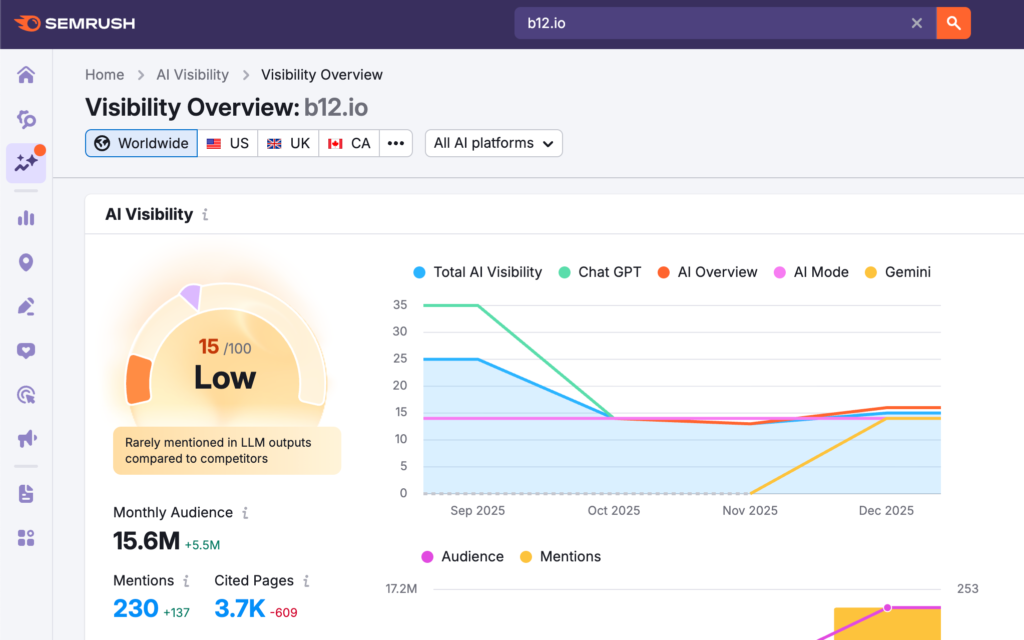
12. Track AI Visibility (Not Just Rankings)
Traditional SEO metrics don’t tell the full story anymore.
You should monitor:
- Whether AI systems cite your content
- How your brand is referenced
- Which pages appear in AI answers
Visibility without clicks is still brand authority and often influences later buying decisions.
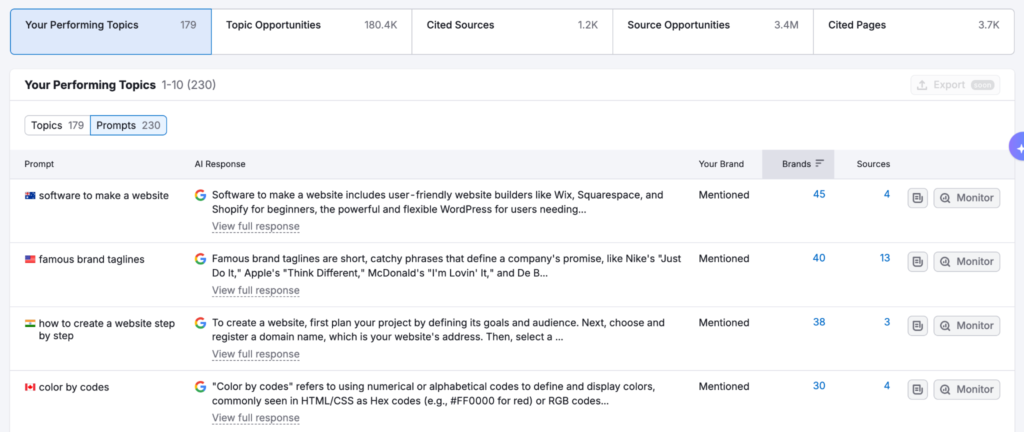
PS. I do highly recommend using an AI visibility tool like Semrush. It helps see where your brand or content is getting cited, what links are getting mentioned and how you can optimize it for conversions.
I personally love using the tool to see what topics and prompts I’m showing up for (a good reality check), and what are some of the opportunities I can tap into.
13. Build Off-Site Credibility Signals
AI systems don’t rely only on your website.
They look at:
- Mentions across the web
- Community discussions
- Third-party validation
This includes:
- Guest contributions
- Citations in industry content
- Thought leadership posts on trusted platforms
- Press releases
Authority is cumulative and distributed.
14. Reduce Content Decay with Intent-Driven Updates
Most content doesn’t fail immediately. It decays.
AI accelerates this decay by favoring newer, clearer, better-structured answers.
To fight decay:
- Re-validate intent regularly
- Merge or prune overlapping content
- Strengthen internal linking
Content that evolves stays visible longer.
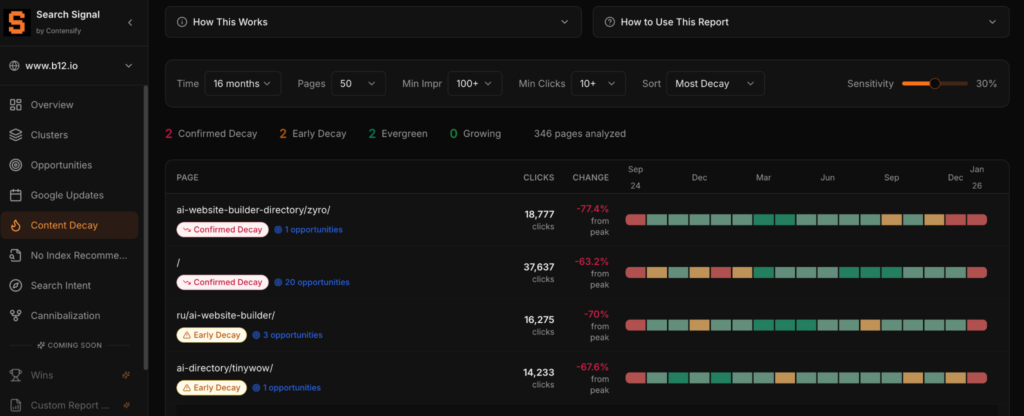
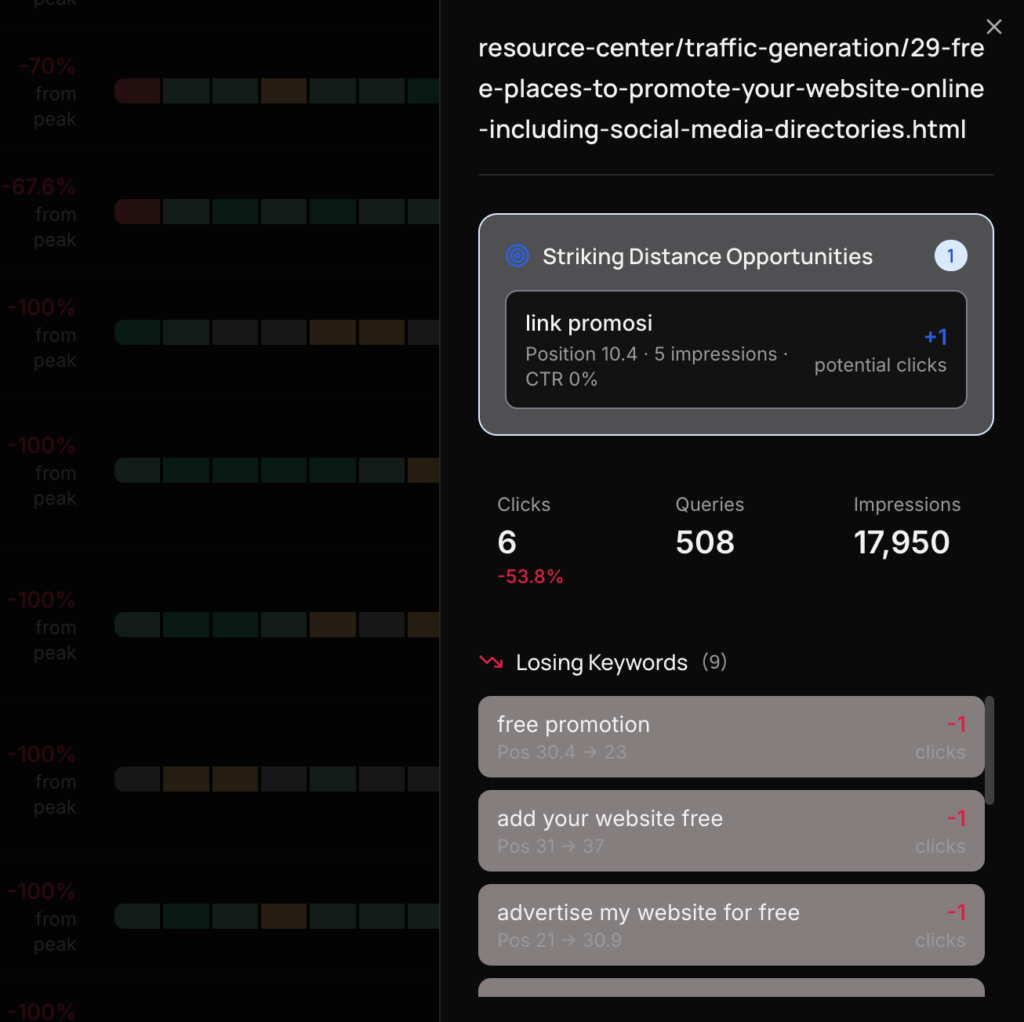
I know this is tougher to monitor and that’s why we actually built Search Signal on Contensify. It helps monitor your content for decay – from confirmed decay to those that are volatile or fast approaching the point of decay.
It then also highlights the opportunities for which you can optimize the content to pull it out of the dropping charts.
15. Design Content to Be Cited, Not Just Clicked
This is the mindset shift most teams miss.
In AI search:
- The answer often matters more than the page
- Being cited builds recall, authority, and trust
- Clicks are no longer the only win
Ask yourself: “If an AI had to explain this topic, would it choose my content?”
If the answer is no, rewrite until it’s yes.
Pro tip: I like to encourage the team to ask ‘why’ for every section they add to a content piece at least 5 times. If you can’t answer why you’re adding it, it’s fluff.
Conclusion
AI hasn’t killed SEO.
It has exposed weak strategies.
And it has definitely killed strategies that banked on content volumes alone.
The brands that are winning AI visibility and conversions at the same time, are the ones that:
- Write for humans
- Structure for machines
- Build real authority
- Treat content as a system, not a one-off asset
If you do that consistently, visibility compounds – whether the click comes immediately or not. Yes, that’s something you need to be okay with.
Need help creating a search strategy that boosts your AI visibility? Work with me and my team.