Have you ever had a prospect come to you and say, “what do you mean by that” or “please help me understand this better”?
Sorry to burst your bubble, but that isn’t an opportunity for you to go into a whole storyline of how good your SaaS product is. It is more likely one of the biggest signs of – you’re SaaS narrative is confusing.
And it’s already costing you customers.
In this post, I’m going to share why I insist SaaS brands use customer language to reframe SaaS narrative.
I’ll also tell you how to do it the right way, without over-simplifying or under-selling yourself.
What is a SaaS Narrative?
A SaaS narrative is the big-picture story of your company that explains why your product exists, who it is for, what makes it different and where it’s going. It’s not just a tagline or a positioning statement – it’s the cohesive storyline that connects your product, messaging and the go-to market strategy.
I like to call it the ‘guiding script’ of the company that marketing uses to write content and campaigns, sales uses to pitch clearly and consistently, product uses to prioritize features that align with the promise and customers use to share ‘why they chose you’.
Why is a Clear SaaS Narrative Non-negotiable?
Most B2B SaaS companies like to start ‘quickly’ with their marketing and sales content. That usually translates to listing and writing about the features they offer – making all their efforts look like an extended version of the sales pitch.
A SaaS narrative isn’t just about what your product does. It’s about how you frame the problem, the solution and the transformation you deliver. The clear narrative:
- Guides messaging across marketing, sales and product
- Helps customers instantly “get” what you do
- Sets you apart in markets that are overcrowded with similar-sounding software
TLDR; without a clear SaaS narrative, you risk confusing your audience, underselling your value or worse – getting ignored.
The Status Quo: Why Most SaaS Narratives Fail
I’m not just randomly talking about SaaS narratives. It comes from years of seeing the best of products fail just because they couldn’t convey their what, why and how clearly.
Here’s the problem – most SaaS companies define their narrative based on how they want to be perceived.
Not how their customers actually talk about their challenges.
That’s why you see homepages full of jargons like:
- “Revolutionizing the future of customer engagement with AI”
- “A next-gen, unified cloud-native platform for seamless collaboration”
- “Elevating work productivity with AI-powered features”
- “Innovative AI solutions to build the next generation of businesses”
Let’s be honest, it sounds grand.
It definitely sounds innovative.
But it also sounds like everyone else who wants to be perceived in the same way.
And to the buyer who just wants to onboard new hires faster, reduce customer churn, those words are absolutely meaningless.
Let me explain this with a bad example of SaaS narrative I recently saw:
“An AI-powered, enterprise-grade orchestration engine for contextualized digital workflows.”
Now for most prospects, this triggers more confusion than curiosity. They leave without actually knowing what the product actually does.
Now lets give you a good example of SaaS narrative too:
“Slack is where the future works.”
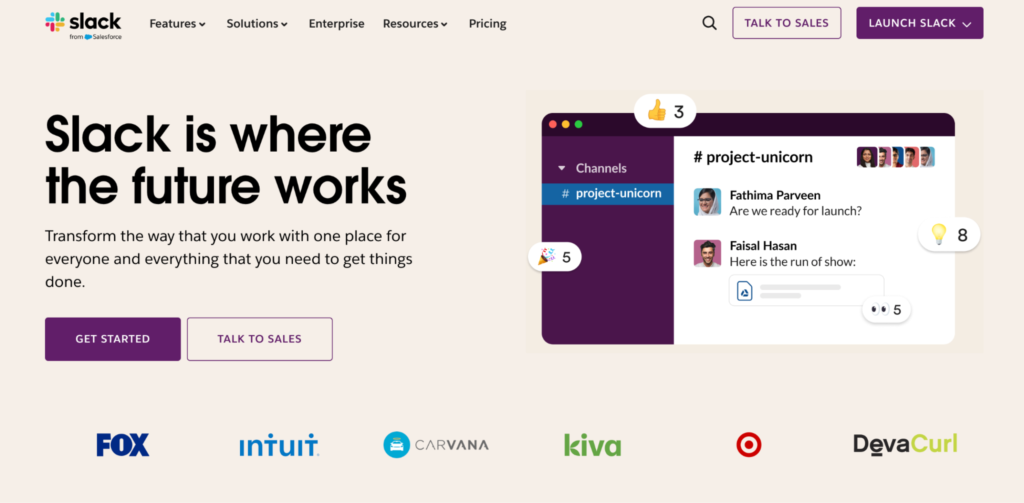
Now this narrative is simple, customer-centric and immediately connects with how the future of work is remote and distributed.
Why Customer Language is Critical for Your SaaS Narrative
Now you may be wondering what copywriting has to do with your SaaS narrative. Let me tell you why embracing your customer language matters:
1. Instant connection
When prospects read their own words mirrored back to them, it signals, ‘this company understands me’ or ‘this company went the extra mile to understand my pain points.’
For example, using ‘cut onboarding time in half’ resonates way more than ‘optimize human resource management processes’ for a HRTech product.
2. Clarity over cleverness
Industry jargon makes you sound like the smartest person in the room, but clarity is what wins deals always. Using customer language simplifies complex solutions without diluting value or having prospects jump from one page to another, or Google searches (that could potentially take them away).
3. Faster movement across the funnel
When your SaaS narrative is relatable, the message gets across much faster. Prospects don’t have to spend endless hours “decoding” what your product does. They’re able to see how it fits into their workflow almost immediately!
There’s a reason why “let’s Slack” has practically become a go-to phrase to catch up with teammates.
4. Stand-out differentiation
If every company talks about being “innovative” or says they are “AI-driven”, but your narrative says “helps you close tickets 2x faster” – you know what you’re instantly drawn too.
We’re all short on time. Simple SaaS narratives are what drive maximum engagement.
How to Weave Customer Language Into Your SaaS Narrative
Now I know how easy it is to also get carried away by all the “lingo” or “slang” your customers use. So let me put a step-by-step together for you:
Step 1: Collect raw customer language
Start by pulling quotes from sales calls, support tickets, directory reviews and online communities. Highlight the phrases your customers use to describe pain points and outcomes.
For example, instead of ‘streamline cross-department collaboration’, you might see customers saying ‘we waste too much time sharing information across departments.’
Step 2: Cluster around themes
Group customer phrases into themes like ‘saving time’, ‘reducing costs’, or ‘better collaboration’ based on the key objectives your product addresses.
For example, if multiple customers say ‘onboarding takes forever,’ that becomes a SaaS narrative that taps into the speed and efficiency you bring.
Step 3: Translate pain points → Promise
Frame your solution as the bridge between the pain points (their words) and your promise (the outcome you deliver with the product). Here’s a simple example to put things into perspective:
- Pain – “It takes us weeks to create marketing reports.”
- Promise – “Generate reports in minutes.”
Step 4: Test in different formats
Once you have a SaaS narrative or versions of it ready, it’s time to test it. Some of the places I recommend A/B testing it on include the homepage headline, ad copy, sales decks and social media posts.
But when you do run the test, listen for resonance through metrics like engagement (not just conversions).
Step 5: Codify into a narrative framework
Once you find a winning SaaS narrative, it’s time to go all-in on it across all key touchpoints. Here’s how:
- Hero statement – a short, customer-centric promise
- Proof pillars – supporting messages tied to customer outcomes
- Product tie-ins – features connected directly back to those outcomes
Best Practices for Using Customer Language in SaaS
SaaS companies often feel they may sound too simple or un-serious when using customer language. Here are some best practices to follow to avoid such scenarios and end up with more confusion:
- Don’t pivot too frequently – Your narrative should evolve, but not flip every month. Constant shifts create confusion and distrust.
- Stay consistent across channels – If your website says you ‘cut onboarding time in half’, your sales deck shouldn’t be saying ‘optimize employee efficiency with AI’. One message at a time.
- Balance customer voice with authority – Mirror their words, but don’t undersell. You’re not just a ‘nice-to-have’ solution; you’re solving a critical problem for them.
- Avoid being too liberal – Look for recurring patterns and not one-off lines like, ‘this tool is a lifesaver’, because that’s feedback and not a headline.
- Update as your audience matures – Early-stage customers may talk about cost savings. But as you move to enterprise prospects, you may have to adapt your narrative to cover concerns about scalability.
Conclusion
Your SaaS narrative isn’t about sounding like the smartest person in the room. It’s about sounding like a company that was built on a thorough understanding of its customers.
By grounding your SaaS narrative in customer language, you stand out in crowded markets, build immediate trust and clarity, and move prospects through the funnel faster – now, isn’t that what we all really want?
In a world full of jargons (and elevating solutions heh), clarity becomes your competitive advantage.
Need help fixing your SaaS narrative? Let’s create one together.