
If I were your CMO or Head of Marketing, I wouldn’t start by asking: “How much new content can we publish this quarter?”
I know a lot of you are going to hate me for this. But I’d ask something far more uncomfortable:
“How much of what we’ve already published is actually working anymore?”
Because in most companies I see today:
- The site already has hundreds (sometimes thousands) of pages
- Traffic looks flat or misleading
- Rankings exist, but authority is leaking
- AI search visibility is inconsistent or nonexistent
And this problem is oh-so-common because AI made it a lot easier to create content.
Take it from my 13 years of experience in building organic growth engines – Publishing more content on top of that doesn’t fix the problem.
It accelerates it.
As you chalk out a plan for Q1 and beyond this year, I need you to understand content decay and why ignoring it in an AI-first search world is one of the fastest ways to lose relevance.
What Is Content Decay?
Content decay is the gradual loss of a page’s ability to rank, attract qualified traffic, get cited or trusted and represent your current expertise. And it doesn’t always show up as a dramatic traffic drop.
Sometimes content decay looks like:
- Rankings sliding from position 3 to 9
- Traffic staying flat while impressions rise
- Pages ranking but never converting
- AI tools ignoring your content entirely
In other words, your content still exists but it no longer competes.
15 Signs of Content Decay (and What to Do About Each)
Here are some common signs of content decay that I see most companies overlook and what you should do instead:
1. Rankings Are Slowly Slipping (But Not Crashing)
What’s happening is rarely dramatic. A page that once ranked in the top three quietly drifts to position six, then eight, then the bottom of page one. There’s no sudden cliff, so the decline feels easy to ignore.
But over time, that slow erosion compounds, especially across multiple pages.
This matters because AI systems are highly sensitive to confidence signals. Sliding rankings suggest declining relevance and weaker alignment with current intent. When AI systems choose sources to trust and cite, they tend to favor content that consistently performs well – not content that’s gradually losing ground.
Pro tip: Instead of reacting only when rankings collapse, treat gradual decline as an early warning. Revisit the page’s intent, improve its structure, and tighten the answers it provides. Small, timely updates often prevent much larger visibility losses later.
2. Impressions Are Increasing, but Clicks Aren’t
In this case, your content is being surfaced more often, but users aren’t choosing it. The page appears in search results, yet something about the title, positioning, or framing fails to convince people it’s worth their time.
For AI systems, this signals weak perceived value. If users consistently skip your result, it suggests your content may not clearly communicate usefulness or authority. Over time, that hesitation becomes a trust issue and not just a CTR issue.
Pro tip: The fix isn’t more keywords. It’s clarity. Rework the title, introduction, and section headers so the value of the page is immediately obvious. Make it unmistakable who the content is for and what decision it helps them make.
What I’m trying to say is, you don’t have to sound oversmart all the time.
3. The Content No Longer Matches Search Intent
This happens when a topic evolves but the content stays frozen in time. The keywords may still be relevant, but the underlying intent behind them has shifted – often subtly. What users want today isn’t what they wanted when the page was first published.
AI systems don’t optimize for keywords; they optimize for intent fulfillment. When your content answers an outdated version of the question, it becomes increasingly invisible, even if it’s still technically “about” the right topic.
Pro tip: Instead of minor edits, step back and reassess intent entirely. Look at current SERPs, AI-generated answers, and follow-up questions users are asking now. Then reshape the page so it reflects today’s expectations, not yesterday’s assumptions.
4. The Content Is Accurate but Generic
The page explains the topic correctly, but nothing about it stands out. It could have been written by anyone, anywhere, at any time. There’s no perspective, no judgment, no sense of experience behind the words.
This matters because AI already knows generic information. What it looks for in sources is added value – insights, framing, or nuance that go beyond common knowledge. Generic content may still rank for a while, but it’s far less likely to be cited or trusted.
Pro tip: To fix this, layer in your point of view. Add sections that explain trade-offs, common mistakes, or things most teams overlook. Even subtle original thinking can dramatically increase how AI systems evaluate your authority.
5. The Page Lacks Clear Structure and Extractable Sections
The content exists as long blocks of text with weak headings and little visual hierarchy. While it might read fine linearly, it’s difficult to scan and even harder to extract specific answers from.
AI systems rely heavily on structure to understand and reuse content.
If answers aren’t clearly segmented, AI struggles to quote or summarize them accurately. Poor structure makes good content invisible.
Pro tip: Rebuild the page with extraction in mind. Use clear H2s and H3s, concise paragraphs, and modular sections that can stand alone. Structure isn’t just for readability, it’s a visibility multiplier.
So now you know why I over-obsess over the formatting of your content!
6. The Page Isn’t Referenced or Cited Anywhere
The content lives in isolation. It has no backlinks, no mentions, and little evidence that other sources acknowledge or rely on it. Even internally, it may not be well-linked.
For AI systems, off-site validation is a powerful trust signal. Content that no one else references appears less authoritative, regardless of how well-written it is. Isolation weakens credibility.
Pro tip: Rather than chasing links blindly, focus on relevance. Strengthen internal linking, cite credible external sources, and distribute the content where it genuinely adds value. Visibility builds trust when it’s earned in the right places.
7. Examples, Tools, or Screenshots Feel Outdated
The page technically answers the question, but the references feel old. Tools mentioned are no longer leading, screenshots don’t match current interfaces, and examples no longer reflect how the industry works today.
AI systems prioritize freshness, especially for topics that evolve quickly. Outdated references signal that the content may no longer be reliable – even if the core advice is still sound.
The solution is disciplined maintenance.
Pro tip: For core pages, update examples and tools regularly. Fresh references reinforce trust and signal that the content is actively maintained, not abandoned.
8. Multiple Pages Compete for the Same Intent
Over time, you’ve published several pieces that address the same or very similar questions. Individually, they might be fine. But together they dilute clarity and authority.
AI systems don’t like conflicting or redundant answers from the same source. When your site offers multiple versions of the “right” answer, trust erodes and visibility suffers.
Pro tip: Instead of publishing more, consolidate. Merge overlapping content into a single authoritative page with clear sub-sections. One strong answer consistently outperforms five fragmented ones.
9. The Page Gets Traffic but Drives No Outcomes
People land on the page, read it, and leave. There’s no clear next step, no decision supported, and no sense of what the reader should do with the information.
AI systems increasingly factor usefulness and engagement into quality assessment. Content that informs but doesn’t help users move forward appears less valuable over time.
Pro tip: Clarify the role of the page. Make it obvious who it’s for and what decision it supports. Content that guides action, not just understanding, signals higher usefulness.
10. There’s No Clear Author or Expertise Signal
The page feels anonymous. There’s little indication of who wrote it, why they’re qualified, or what experience informs the advice.
In an AI-first world, who is speaking matters more than ever. AI systems use expertise signals to determine trustworthiness, especially for complex or high-impact topics.
Pro tip: Strengthen authorship. Add clear author bios, experience context, and first-hand insights. Make it obvious that the content comes from real expertise, not a content factory.
11. Internal Linking Is Messy or Inconsistent
Links feel random, outdated, or missing entirely. Pages that should reinforce each other don’t, and the overall topical structure feels unclear.
Internal links help AI understand how topics connect and which pages are most authoritative. Weak internal linking blurs those signals and weakens topical depth.
Pro tip: Rebuild internal links intentionally. Create clear pillar-to-cluster relationships and link contextually where it adds meaning – not just for navigation, but for understanding.
This is why internal linking shouldn’t just be a best practice for the writers to follow. Sometimes, you have to take it up as an intentional exercise.
12. The Content Ignores Major Industry Shifts
Significant changes – AI, regulations, product evolution, have reshaped the landscape, but the page hasn’t been updated to reflect them.
AI systems are ruthless about accuracy. Content that ignores major shifts is treated as incomplete or unreliable, even if parts of it are still valid.
Pro tip: Address changes directly. Add updated context, new sections, and clear timestamps that signal relevance. Acknowledging change builds trust faster than pretending nothing happened.
13. AI Tools Rarely Reference Your Brand
When you test AI tools or search experiences, your content doesn’t appear. Even when it should be relevant, it’s absent from AI-generated answers.
This is a visibility gap traditional SEO metrics often miss. If AI doesn’t recognize your content as a reliable source, your authority isn’t carrying over into new discovery channels.
Pro tip: Focus on clarity, structure, and authority rather than volume. Then actively monitor AI visibility to understand where trust breaks down.
14. The Content Solves a Problem You No Longer Want to Own
The page addresses a topic that no longer aligns with your strategy or positioning. It might still get traffic, but it pulls your brand in the wrong direction.
AI evaluates topical consistency across your site. Legacy content that conflicts with your current focus weakens overall authority signals.
Pro tip: Decide intentionally: prune, redirect, or rewrite the page so it aligns with where you want authority to compound; not where it used to.
15. New Content Feels Easier Than Fixing Old Content
Publishing something new feels productive. Auditing and fixing existing content feels slow, messy, and uncomfortable. That’s why it always gets postponed.
This avoidance compounds decay. Over time, the site fills with underperforming pages that dilute authority and confuse both users and AI systems.
Pro tip: The better move is restraint. Pause publishing, audit what exists, fix what matters, and only then scale. Sustainable visibility comes from discipline, not output.
PS. If you do have the resources to move both new publishing and refreshes in tandem, set a regular cadence for it.
Why Content Decay Matters More in the Age of AI Search
Traditional search was still forgiving. AI search is not – think about the number of times you’ve wondered ‘where did AI pick this information up from’.
Here’s what’s changed:
1. AI systems don’t just rank, they choose
AI doesn’t list 10 blue links and let users decide. It synthesizes answers and selects sources it trusts.
Decayed content:
- Gets skipped
- Gets contradicted
- Gets replaced by clearer, fresher sources
2. AI accelerates winners and losers
Strong, well-maintained content compounds visibility. Weak or outdated content disappears faster than before.
There’s no middle ground anymore.
3. Authority is evaluated at the system level
AI doesn’t look at pages in isolation. It evaluates:
- Topical consistency
- Freshness across clusters
- Internal contradictions
- Signal alignment across your site
One decayed cluster can weaken the perceived authority of everything around it because you cannot entirely control what sources AI refers to.
How to Find Content Decay with Search Signal
If you’ve been publishing content for a while, I know this is going to look like an endless task. Me and my team have sometimes spent months pruning, refreshing and updating content for some of our clients.
That’s why we built Search Signal. Here’s a step-by-step on how you can find content decay:
1. Create an account on Search Signal
First things first, you need to head over to Search Signal and connect your Search Console. This should be through an account that has access to your website’s property – this is the website you want to monitor content decay on.
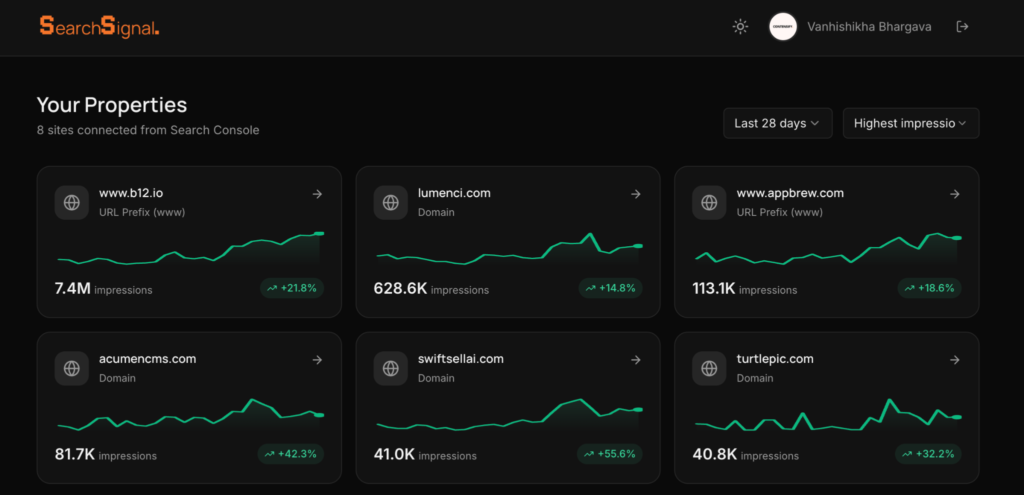
2. Select the property you want to analyse
Once you’re logged in, Search Signal will automatically pull all the properties you have access to view data from. Next, click on the website you want to deep dive into to see the analysis that Search Signal has completed.
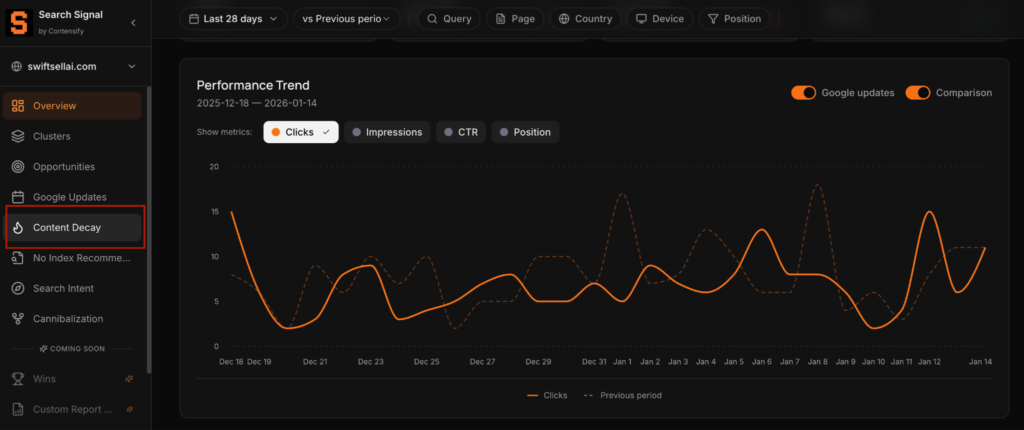
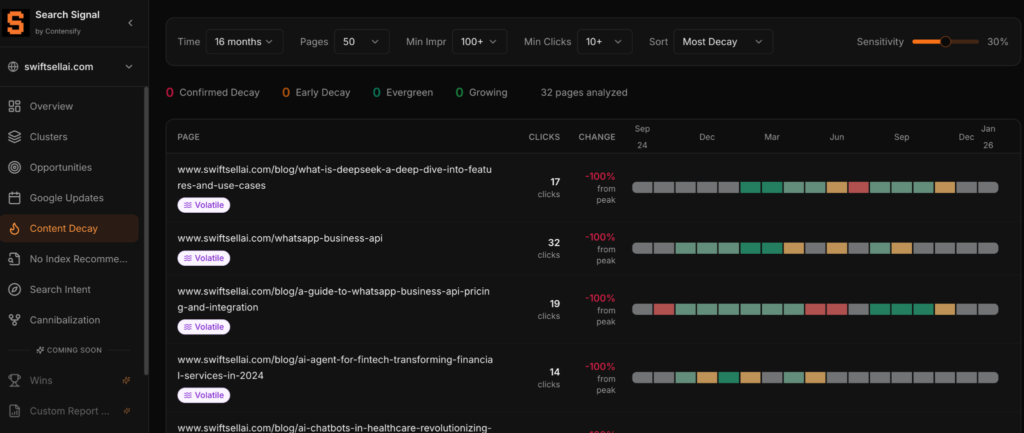
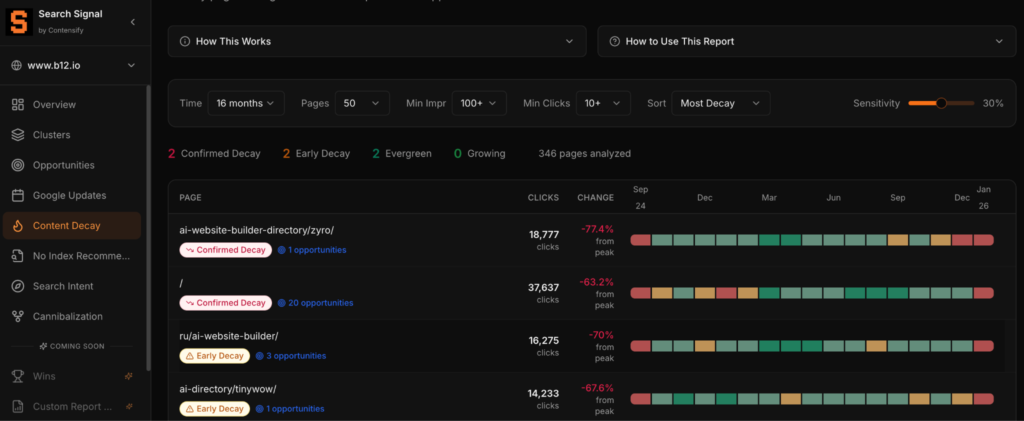
3. Click on Content Decay
Once you click on Content Decay, Search Signal will open up the analysis it has made. This includes a rundown and categorization of all your URLs into – confirmed decay, early decay, evergreen and growing.
In fact, you’ll also be able to see the URLs that are volatile. These are the ones that can tip the scale at any given time!
4. Click on the link to identify Opportunities
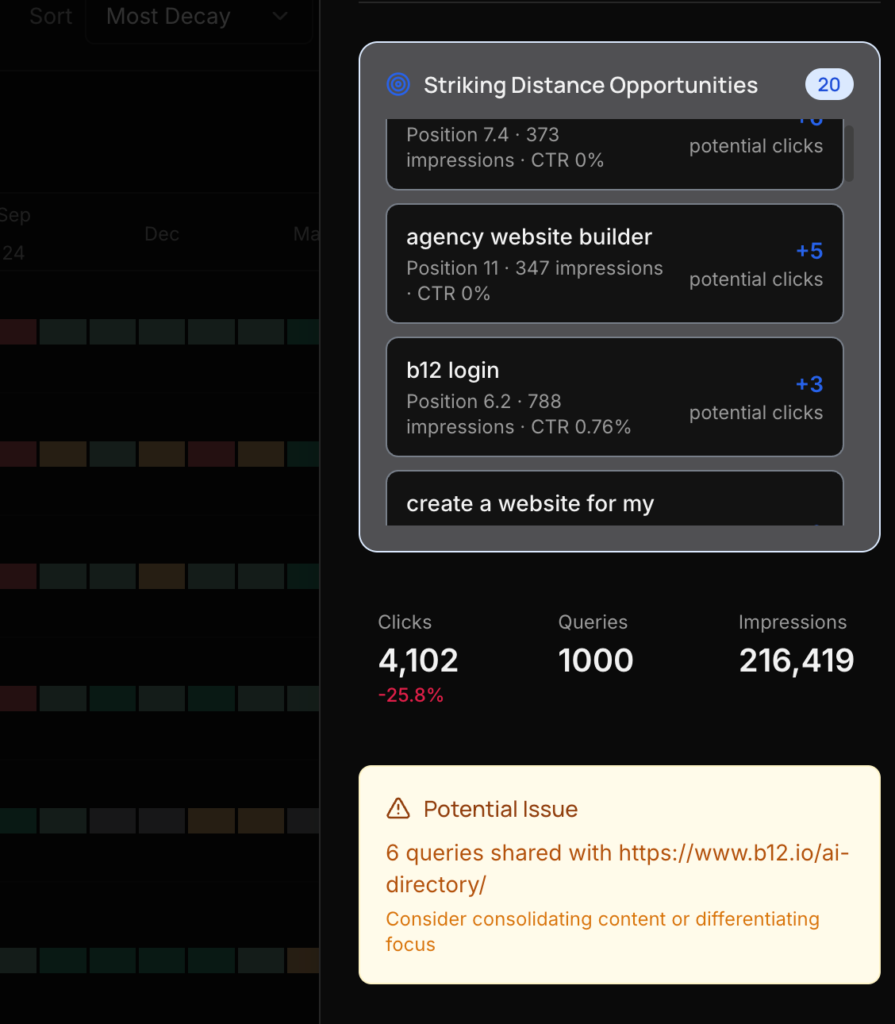
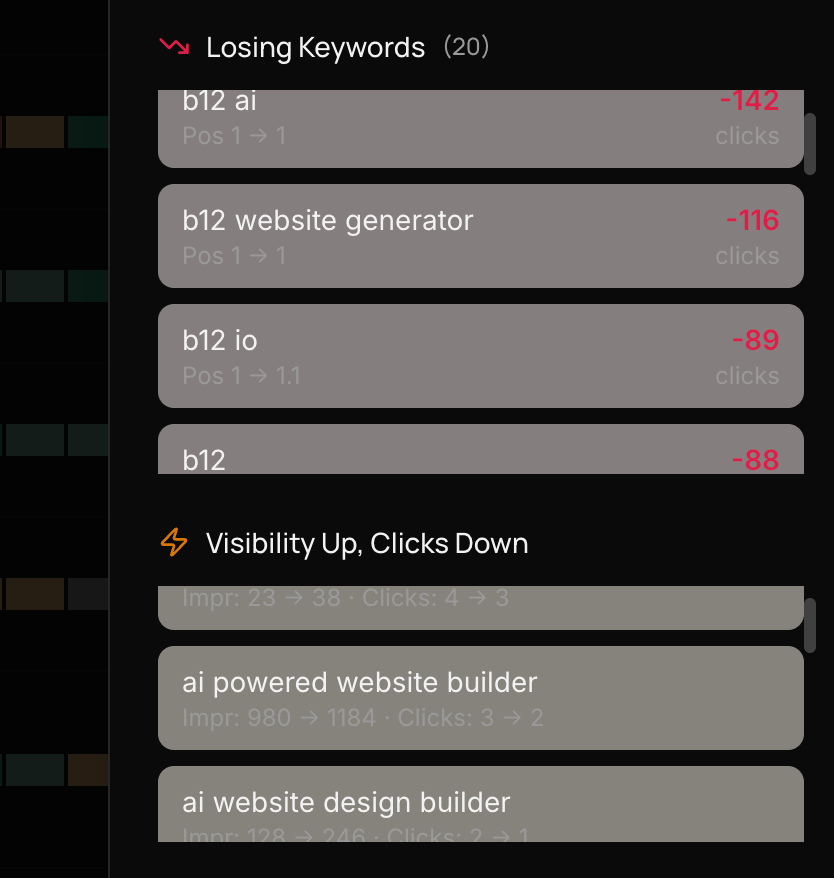
Next, you want to see what you can do to save the content that is decaying or has decayed. Search Signal also highlights the opportunities so that you don’t have to guesswork the updates or refreshes.
5. Update your content and monitor performance
Once you have implemented the changes above, we recommend you closely monitor how these content pieces start to perform. You want to closely watch the movement – be it up or down, as it will give you better direction for your next content strategy.
Conclusion
Content decay is no longer a problem to solve for ‘later’.
If you have been creating a lot of content over the last few years – human or AI, you need to audit it before you fall into creating more slop for your business.
Need help navigating content decay and your search visibility strategy? Reach out to me and work with my team.
Want to fix content decay on your own? Get started with Search Signal today.